
Milk had started souring three or four days early for a couple of weeks straight. The compressor was struggling badly once we watched it under load, and swapping it fixed the problem entirely.
Ashcombe P.
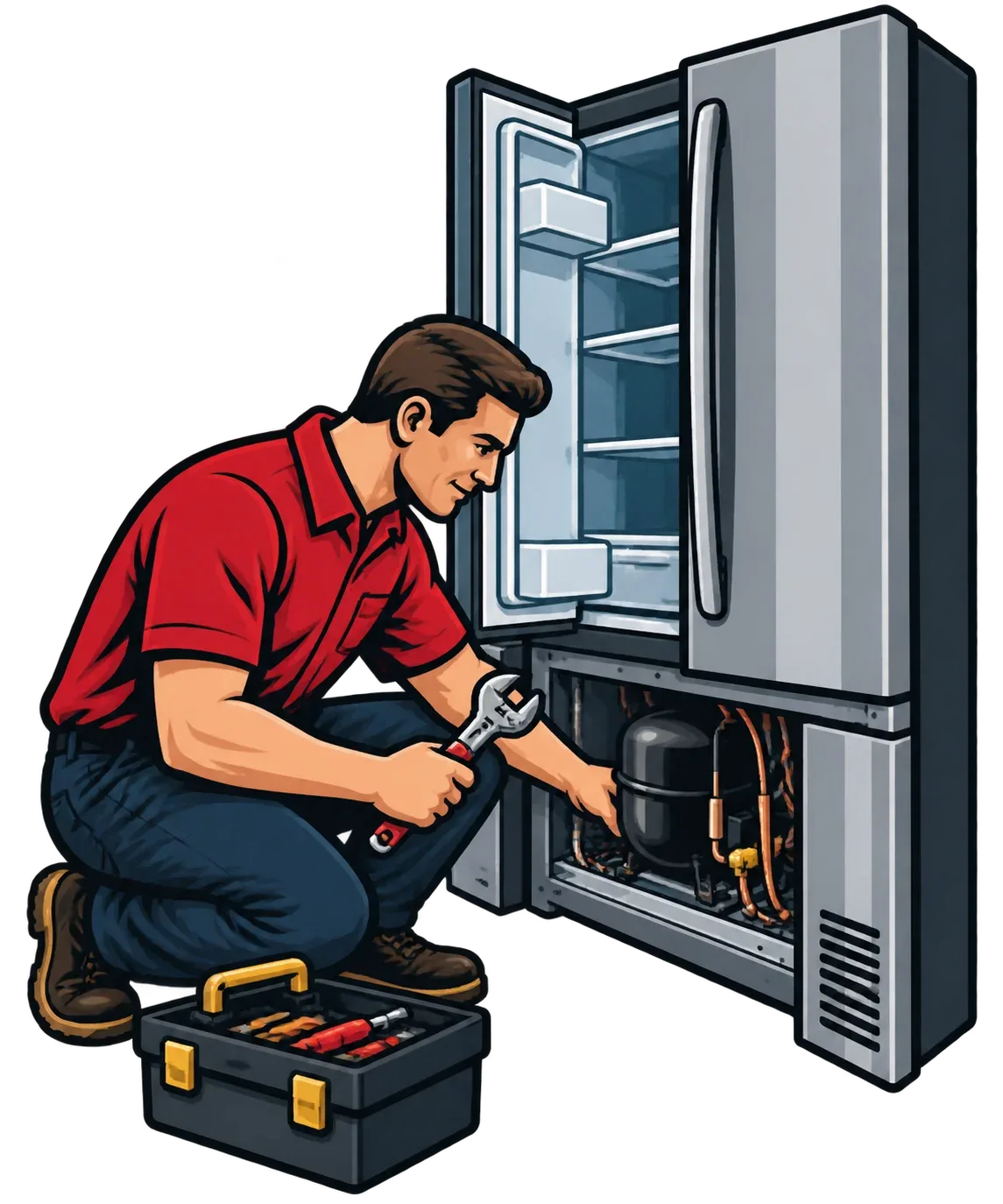
A unit that's lost its chill, a puddle you can't explain, or a compressor that never rests, our crew pins down what's actually failing before ever suggesting a full replacement.
Tap through to see what's usually going on and how we handle it.
Ice Maker Dead
Press the dispenser and absolutely nothing comes out, no matter how long you hold it. In most cases, the small tube carrying water toward the mold has frozen solid somewhere along the way, usually right where it passes close to the back wall. It happens year-round, not just in winter, since the freezer compartment stays cold regardless. Locating the frozen section and thawing it carefully is typically enough to get things flowing again.
Constant Frost Buildup
You clear the freezer walls one week and the frost is thick again the next. A defrost heater that's stopped cycling is the most frequent cause, meaning the automatic melt schedule has quietly stopped happening. A door gasket that's lost its seal can produce nearly the same symptom by letting warm, humid air seep in nonstop. Testing both determines which one actually needs replacing.
Running Warmer Than It Should
Things just don't feel properly cold, and milk seems to turn a couple of days early. An airflow vent blocked by items packed in too tightly is a common and easy-to-fix cause. A compressor that's gradually lost efficiency after years of use is the less convenient possibility. Working through the cooling system methodically identifies which one applies before any parts get ordered.
A Strange New Noise
Something you never used to hear has started up recently and only seems to intensify. Bearings wearing out inside the evaporator fan, the part circulating cold air through the compartments, is the typical explanation after years of continuous spinning. Occasionally the unit has simply drifted out of level, causing a nearby panel to rattle against the frame. Pinpointing the exact source comes before any part gets replaced.
Water Leaking Onto The Floor
A puddle appears near the base with no obvious spill or crack to explain it. This nearly always traces back to the internal defrost drain, which has become blocked with ice or trapped debris, eventually causing water to back up and spill out in an unexpected spot. Clearing the entire length of that drain channel, rather than just the visible opening, is what actually keeps the puddle from returning.
Compressor Never Shuts Off
It seems to run nonstop, and the side panel feels distinctly warm even overnight. A heavy coating of dust across the condenser coils tends to be the leading explanation, since it blocks the airflow the unit needs to cycle down properly between runs. That's typically a fast fix, and doing it often lowers both the running noise and the monthly power bill.
Types We Service
Every manufacturer does this a little differently, so treat these as general patterns rather than your model's exact manual.
Since brands rarely agree on exact meanings, use this list as a starting point rather than gospel. If yours keeps returning after a reset, have someone come read it properly.










What customers said once their fridge was sorted.
Quite a few service calls end up being something small you could've caught on your own.
Double-check the temperature dial
It doesn't take much, a shopping bag or a curious hand, to knock the setting off without you noticing. Look for numbers near 38°F in the main compartment and around freezing in the freezer.
Move items away from the vents
Containers pushed right up against the cooling vents inside stop air from circulating the way it needs to. Give the openings some breathing room.
Pinch the rubber seal shut
Trap a sheet of paper in the door and see how easily it slips out. Almost no resistance usually points to a gasket that's stopped sealing properly.
Rule out the wall outlet
Swap in a lamp or charger at that same spot first, just to make sure the outlet itself is actually delivering power.
Check the gap behind the unit
Shoved tight against a wall, a fridge can't vent the heat it generates. A modest gap on all sides lets it breathe properly.
Look for an uneven stance
An unlevel fridge tends to buzz noticeably or send condensation running the wrong direction. The front legs typically twist to adjust by hand.
Ran through all that and nothing changed? It's likely something a proper visit can sort out. Book a technician and we'll take it from there.
Drop your info below and expect a call to nail down the timing.
Thank You!
Your message has been sent successfully. We'll get back to you shortly.
Thank You!
Your message has been sent successfully. We'll get back to you shortly.
Prefer to talk it through? (902) 449-2551